A wavetable synth for macOS, for people who tune their own scales — and who need to show the music they make. Your sound draws the real figure it makes on a vibrating plate, live, sixty times a second.
The waitlist price isn't a launch discount everyone gets. It's the code I send to the people who were here first.
Day one. You'll have made a Chladni figure with your own hands — and changed it by changing the plate, not the note.
Week one. You'll hear a just third against an equal-tempered one, and know which one you prefer — that doesn't go away when you close the plugin. And you'll have put a bell on one key and a drone on the key next to it, and started wondering what else a keyboard could be.
Month one. You'll have released something with a video you didn't commission, didn't license, and nobody else has.
Not an animation you commissioned. Not a template a thousand other releases are also using. The actual physics of the sound you wrote, rendered offline at up to 4096×4096, with your audio already inside the file.
You record light and keep playing. The high-resolution file renders afterwards, in the background, on its own thread — later that day, or days later, while you work on something else. Same take, same result, every time: the render is reproducible down to the grain.
And a still at full resolution whenever you see something worth keeping. The video for the release and the cover for the single come out of the same note.
The demo exports too. It leaves a small engraved signature, and that's the only thing I ask in return.
It opens on September 13, 2026. Leave your email and I'll write to you the day it does — one message, no countdown games.
€59 for the waitlist — a personal code, good for two weeks after launch. €89 for everyone else in the first few weeks. €129 after that. One payment, yours forever, no subscription — and if you own Sonicrama V1, the upgrade is €39.
The waitlist price isn't a launch discount everyone gets. It's the code I send to the people who were here first.
Most synths give you sound. Sonicrama gives you the sound and the shape it makes — the two are the same object, computed together, in real time.
The instrument at work: the exciter driven by LFOs, by velocity and by key position, and the plate answering as you play.
A normal synth spreads one sound across the keyboard. Here you build the keyboard itself.
Any key can hold its own oscillators — its own frequency, waveform, morph position, gain, pan, phase, stereo delay offset, binaural pair. Not a layer, not a key switch: that key is a different instrument. Leave a key alone and it plays the default patch; change one and only that one moves. I call it meta-tuning.
So a single patch can hold a bell at the bottom, a drone in the middle and a binaural pair three octaves up — and you play it with one hand.
Underneath: four oscillators, .scl/.tun import and export, a free root, a different tuning table per oscillator. Unison ×7, eleven filters, four Bézier envelopes, a modulation matrix, your own WAV wavetables.
A GPU engine solves the modal equation of a real vibrating plate — Bessel mode shapes, Faraday-wave dispersion for liquids — and drives 400,000 particles with your audio, live. For the sand plate the frequencies and spatial scale are physically exact. Not a visualizer inspired by cymatics: a modal solver, with its lenses declared.
One note, a thousand figures — because the figure belongs to the system, not to the number.
Feed the plate a frequency and the grains arrange themselves into its modal figure — the same experiment Ernst Chladni first drew with a bow in 1787, now solved 60 times a second on a GPU. Every figure is the exact answer to a specific tone on a specific plate.

Cross-checked against published Chladni-plate measurements — Tuan et al., J. Acoust. Soc. Am. 137, 2113 (2015). Read the paper →
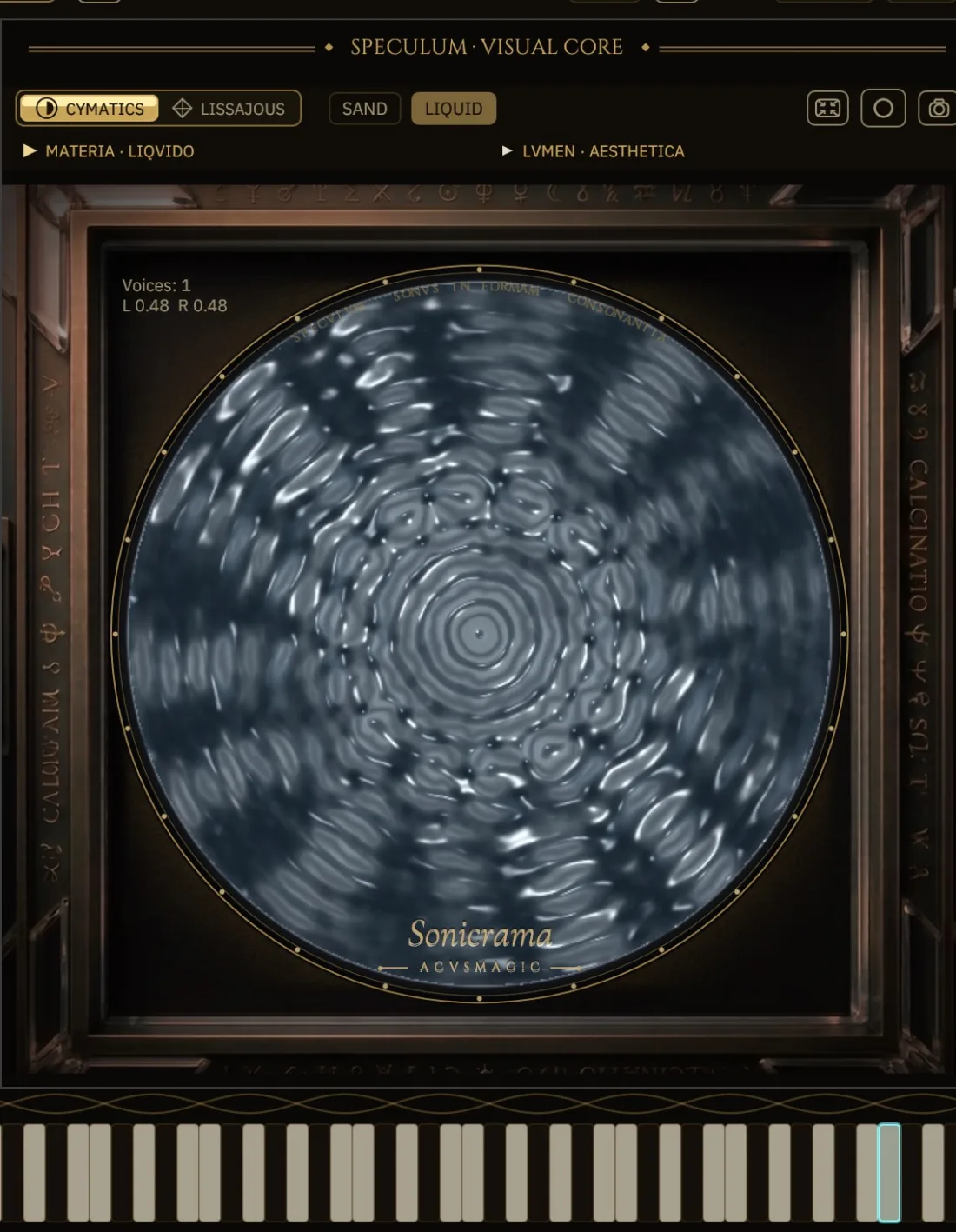
Switch the vessel to liquid and the surface answers with Faraday-wave dispersion — the caustics you'd see in a real driven fluid. Adjust density, viscosity, depth: the mathematics follows the material, not a preset animation.
On the sand plate the modal frequencies and the spatial scale are physically exact — no zoom, no fitting. Sand renders true at any size — the mode shapes are analytic, so more pixels mean more detail from the same physics. On the liquid plate, spatial frequency is log-compressed above roughly 40 cycles: real Faraday cells at audio rates are millimetric, and a 1:1 render would be unreadable. The liquid field is 512 points by nature: its patterns have a characteristic wavelength and there is nothing above it to recover, so it's rendered at full size rather than simulated at full size. Non-circular plates use an averaged effective radius, since their true eigenvalues aren't Bessel. Every one of these lenses is also declared inside the plugin, in the tooltips, where you can see it while you work.
The Lissajous view traces the raw geometry of the signal itself: two oscillators, one luminous figure. Two temperaments on the same chord draw two different curves — you can see the tuning.

Close your eyes for these. Everything else on this page is something to look at. This is the part you have to hear. Eight short clips — the first two are the whole argument: the same chord in two temperaments, and one note on five different plates.
528 Hz, held. I never touch the note. I change the plate: thickness, tension, material, size, shape. The figure belongs to the system, not to the number. (528 Hz: Puleo & Horowitz, 1999.)
Excerpt — the full, uncut take is here.
Nothing moves but the third: 400 cents down to 386. Listen to the beating slow down and stop. That's the interval landing.
One held chord. I swap the tuning table underneath it — Pythagorean, meantone, equal. Nothing retriggers.
Same note the whole way. I only change the waveform. A square has odd harmonics only; a saw has all of them at 1/n — and every partial excites the modes nearest to it.
Faraday waves, computed live. On the liquid plate spatial frequency is log-compressed for readability — real cells at audio rates are millimetric.
A one-minute piece, played by five instances of Sonicrama and nothing else. Every sound you hear is the synth itself — no effects added, nothing touched afterwards. The picture follows the arrangement: the liquid plate enters first, then sand, then a Lissajous pair — each figure drawn by the part that plays it.
The harmonic series, played as a scale. Sixteen through thirty-two, straight off the overtone ladder. Where scales come from →
If you make ambient, drone, modular or anything where the timbre is the piece. If you've ever loaded a non-equal scale, or wanted to and didn't know where to start. If you release your own music and have to make the visuals yourself.
Today you'd do this with a free synth and a visualizer bolted on beside it — two workflows, and an image with no relation to the sound.
And who it isn't for. If you want a synth that arrives pre-solved, with four thousand presets and a browser to hunt through, this isn't that. If you're on Windows, it isn't yet — there's a Windows list under the specs below: leave your email and I'll write to you the day it's ready, rather than promise a date.
Export — MP4, square, up to 4096 × 4096, 30 or 60 fps, audio embedded · PNG stills at the same sizes · reproducible renders
Runs in Logic, Ableton, Bitwig, Reaper and more. Windows is planned — I'd rather say "when it's ready" than promise a date; if that's you, the list is right below.
Leave your email and I'll write to you the day the Windows build is ready.
A separate list from the launch waitlist. You'll also get the occasional release note — a few a year at most. No spam, no sharing, unsubscribe anytime.
Soon — it's in the final stretch. Leave your email and you'll hear it from me first, the day it opens. No countdown games, just one message.
Yes — a free demo you can keep. The moment it's out I'll send you the link, so you can try the whole thing before you decide.
September 13, 2026. Leave your email and you'll hear it from me first, the day it opens. One message, no countdown.
€129 once, and it's yours forever — no subscription, ever.
The waitlist pays €59 at launch;
everyone else pays €89 for the first weeks. If you own Sonicrama V1, the upgrade is €39.
Yes, and you can keep it. Sessions run 15 minutes (reopen to continue), exported clips carry a small engraved signature, and presets can't be saved. Every sound-design feature is unlocked: all four oscillators, the full tuning system, the physics engine, 4K export. The demo never expires — I'm not rushing you.
AU, VST3, CLAP and standalone, from day one — Logic, Ableton, Bitwig, Reaper and anything that hosts those. macOS 11 and up, universal binary for Apple Silicon and Intel. Windows is planned; I'd rather say "when it's ready" than give you a date I might miss — if that's you, leave your email in the Windows list under the specs and you'll hear from me that day.
One perpetual licence, activated on up to 3 machines, used one at a time. Fully offline — no server check, ever — and resellable. Activation happens once per machine through your browser; you never type a password into the plugin.
No. Preset state round-trips exactly — every parameter is stored with exact round-trip precision, so the preset you reload in five years is the one you saved, down to the last float. The file also records when it was saved and by which app version; those are the only things that ever change.
Both, and I'll tell you exactly which is which. The engine solves the modal equation of a vibrating plate (Bessel mode shapes) and Faraday-wave dispersion for liquids, driven by your actual audio. On the sand plate, modal frequencies and spatial scale are physically exact, cross-checked against published Chladni-plate measurements. On the liquid plate, spatial frequency is log-compressed for readability, and non-circular plates use an averaged effective radius. Every lens is declared in the plugin's tooltips.
No. It sounds like a synth if you never touch a scale. But if you want to start, the tuning is the reason most people stay — and I've written the introduction I wish I'd had.
Every one of the 128 keys can override the instrument's defaults — not just its pitch, but its waveform, morph, gain, pan, phase, delay offset and binaural pair. Keys you don't touch follow the patch. Keys you do become their own small instrument. It's why the same patch can be a bell down low and a drone in the middle.
Try the demo first, for as long as you want; that's what it's for. If you buy and change your mind, 14 days, no questions.
AcusMagic is the name on the instruments; Zaplab is the company that builds them and handles payments and licences. Same desk, same person. Your card statement will show ZAPLAB.
I make Sonicrama on my own. Every choice on this page, and every answer to your email, comes from me. If you want to talk about the ideas behind the instrument — the research, the music, the old questions about sound — I read everything.
— Paolo · AcusMagic